One connected workflow, deployed and usable.
(Built by Ariel Magalso)
A guest-support AI designed to know when it does not know.
Guest Desk is a production-shaped SaaS for small hotels and resorts. It combines property-scoped retrieval, evidence checking, human handoff and connected guest operations in one working system.
Draft generation followed by evidence verification.
Development-set results across six behavior categories; not a held-out benchmark.
Architecture
The complete answer path
Every boundary is explicit, from the first guest message to the staff inbox.
- 01Guest message
A private guest link or embedded website widget starts the flow.
- 02Scoped retrieval
Search is limited to approved knowledge for the guest’s property.
- 03Grounded draft
Claude receives the question, recent conversation and retrieved sources.
- 04Independent check
A second model pass rejects unsupported or conflicting claims.
- 05Safe decision
A supported answer is sent; uncertainty switches the thread to staff.
- 06Shared workspace
The answer, sources, requests and staff replies stay in one conversation.
Approved information only
Draft and archived articles are excluded. Queries and fallbacks remain scoped to one property.
Staff keep authority
The assistant cannot approve late checkout, confirm availability, promise prices or complete requests.
Takeover wins
The system rechecks thread mode before saving a model response, so a late AI answer cannot override staff.
In the product
The same path, captured from the running app with demo data.
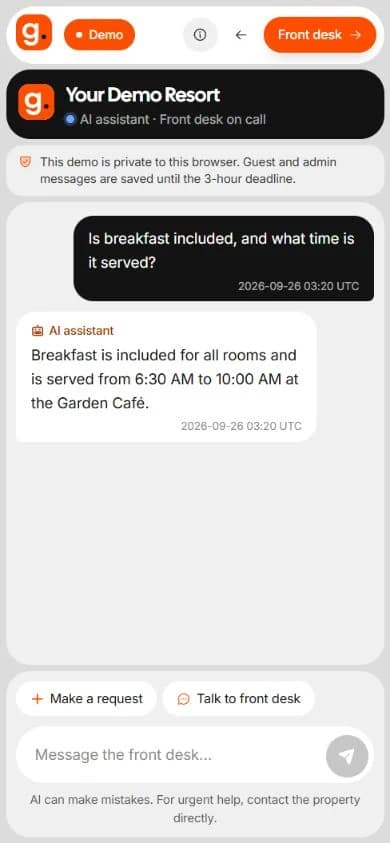
Guest asks, AI answers
A guest question on the private link, answered from approved knowledge only.
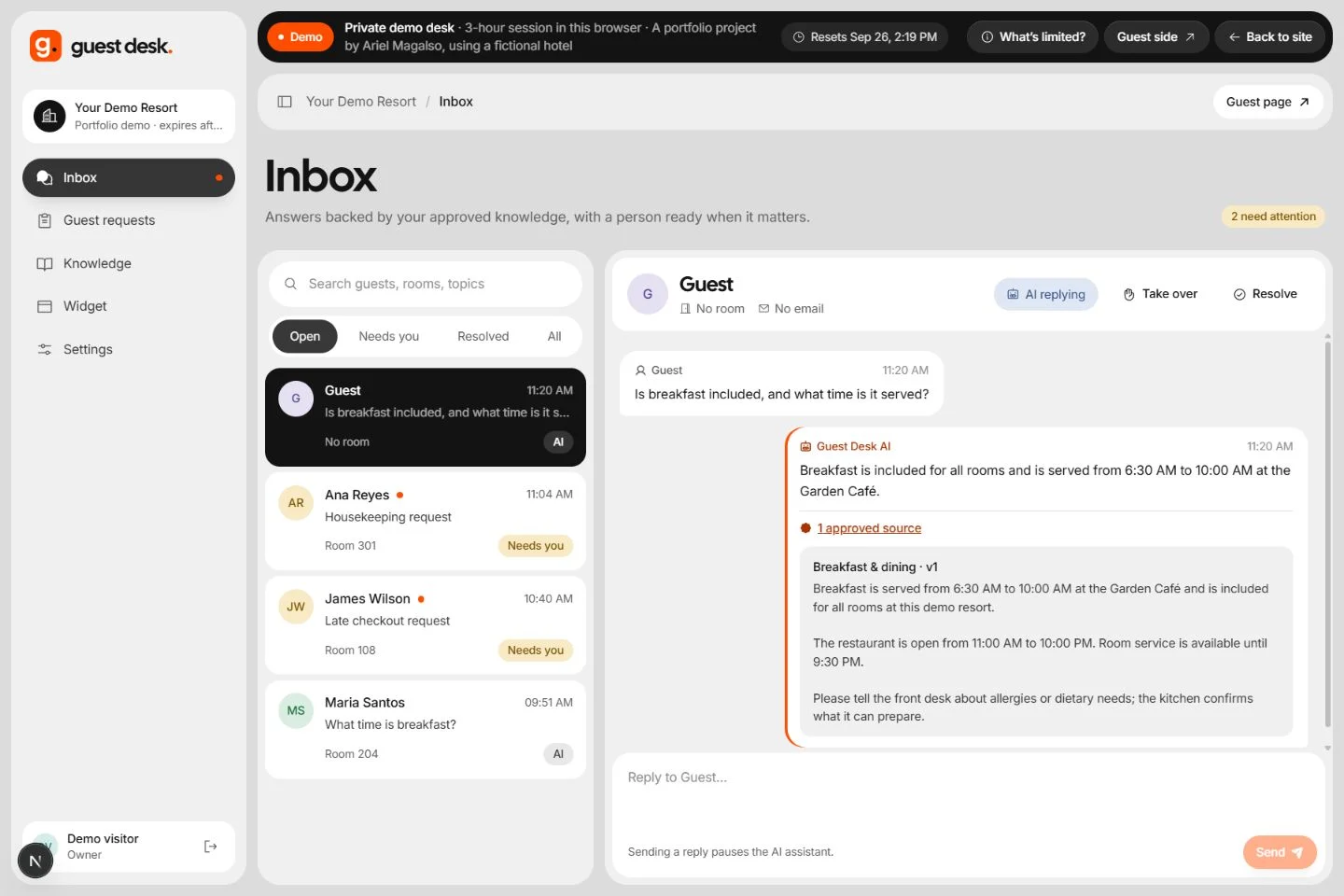
Sources travel with the answer
Staff see the exact approved article and version behind every AI reply.
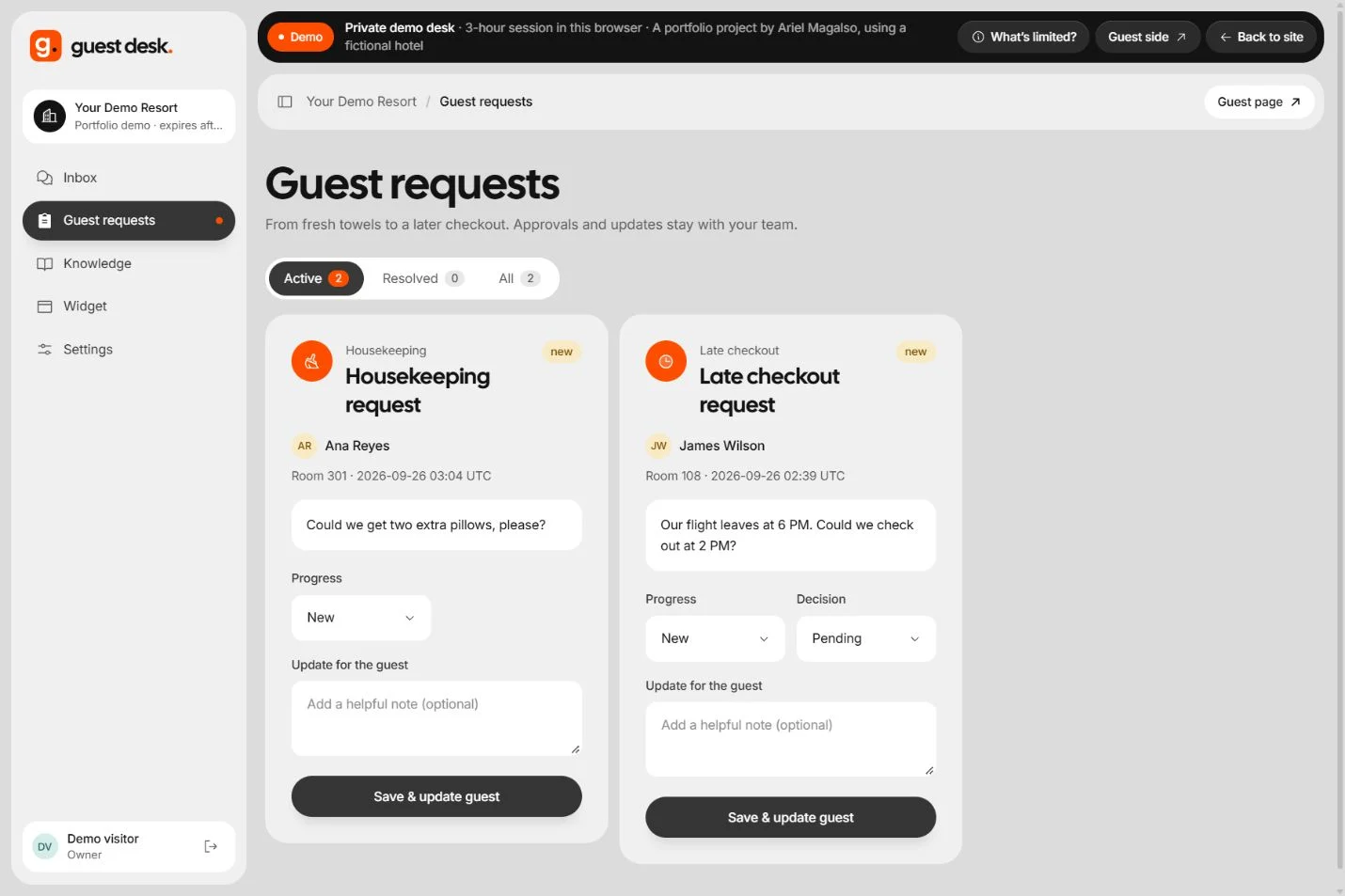
Requests stay with people
Late checkout and housekeeping land in one queue; approvals are always a staff decision.
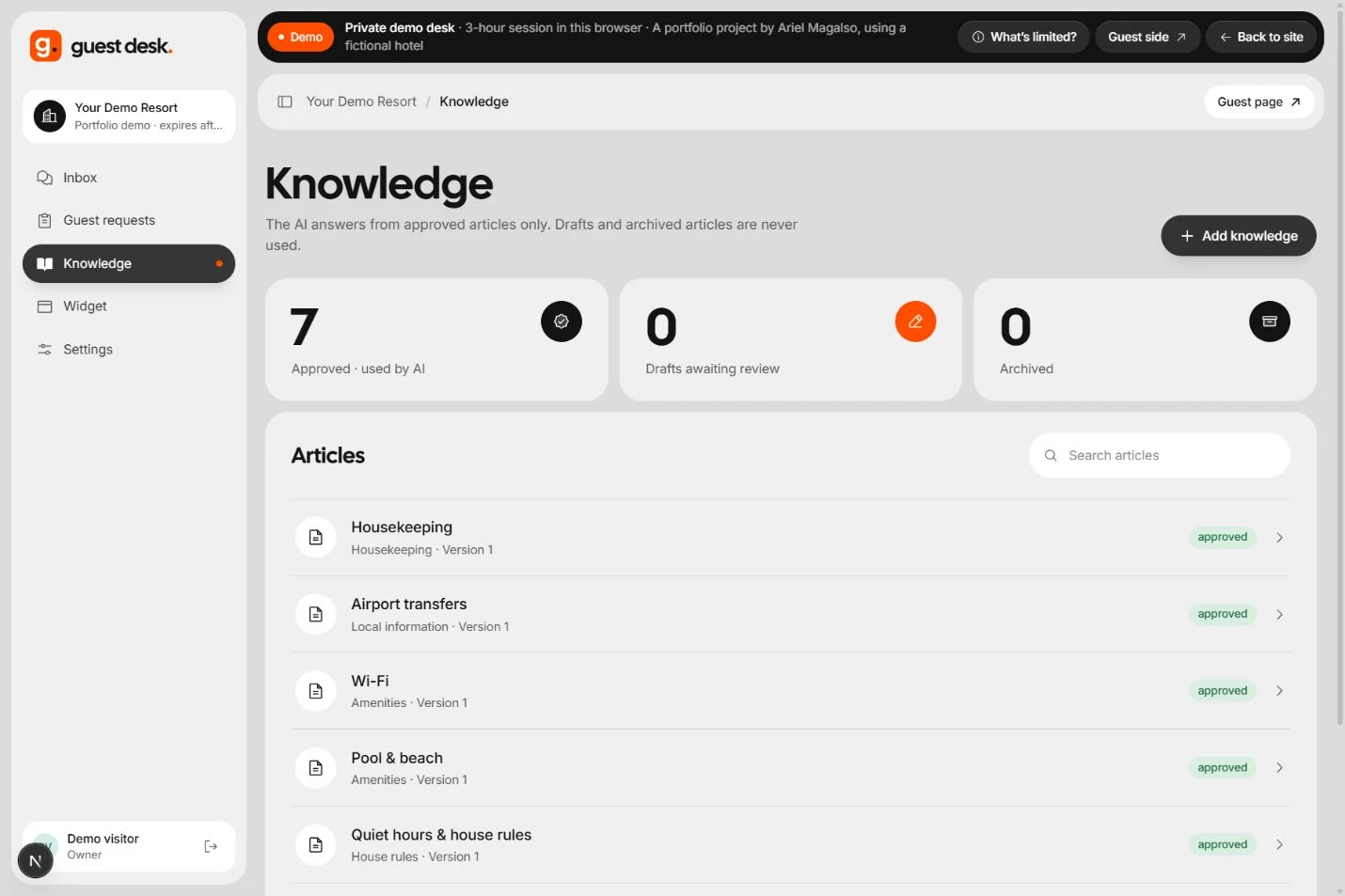
Only approved knowledge
Drafts and archived articles are never retrieved. Every change is versioned.
Model evaluation
Designed to be measured
The checked-in suite covers 50 fictional hotel scenarios. It creates an isolated property, exercises the real guest API and removes all test data after the run.
100%
Measured
Latest model-quality baseline
50 of 50 development scenarios passed · claude-sonnet-4-6 · September 26, 2026
7.7sMedian latency
11.5sp95 latency
- Property facts15
- Missing information10
- Service requests10
- Human handoff5
- Prompt injection5
- Follow-ups5
Property facts
Times, facilities, Wi-Fi and policy questions
Missing information
Questions the approved knowledge cannot support
Service requests
Housekeeping, maintenance and approval workflows
Human handoff
Explicit requests for a person
Prompt injection
Attempts to override rules or expose secrets
Follow-ups
Questions that depend on recent conversation context
A scenario passes only when the observed behavior matches its expected outcome. Factual answers must contain the required facts and carry source evidence. Unsupported questions and injection attempts must hand off. Requests must persist with the correct operational category.
Measured performance
Removing the waiting from the workflow
Production route audit, September 25, 2026. Values compare the second full response before and after server rendering, client cache reuse and Singapore-region placement alongside Supabase.
Admin inbox93% faster
Guest chat93% faster
Guest welcome88% faster
30automated checks
Cover resource caching, stale-response protection, invalidation and other regression paths, alongside integration tests for tenant isolation, source grounding, requests, takeover and guest-visible staff replies.
Limits and tradeoffs
What the system deliberately does not do
No reservation access
It cannot see bookings, availability or live rates. Those questions go to staff.
No autonomous approvals
Late checkout, discounts and special arrangements remain human decisions.
No hidden benchmark claims
The case study publishes model-quality results only after the live suite is run and reviewed.
Try the complete story
Ask as a guest. Then take over as the front desk.
- 1Ask “What time is breakfast?” and inspect the answer.
- 2Create an extra-towels request.
- 3Open your private admin desk and reply as staff.